
Why is the hexagonal demolition hammer more suitable for concrete demolition than a standard electric hammer?
In concrete demolition scenarios, the hexagonal demolition hammer demonstrates greater adaptability and efficiency compared to standard electric hammers—a consensus increasingly reached by construction teams and cross-border procurement professionals. Many users report that standard electric hammers often stall or lack sufficient impact power when breaking concrete, not only delaying project timelines but also risking equipment damage and operator fatigue due to excessive vibration. This article dissects the core differences between the two, highlights the advantages of hexagonal demolition hammers, and outlines key selection criteria to help you precisely match your construction needs. Below, we explore the adaptability logic of hexagonal demolition hammers from critical dimensions.
Why does the hexagonal drive structure enhance concrete demolition efficiency?
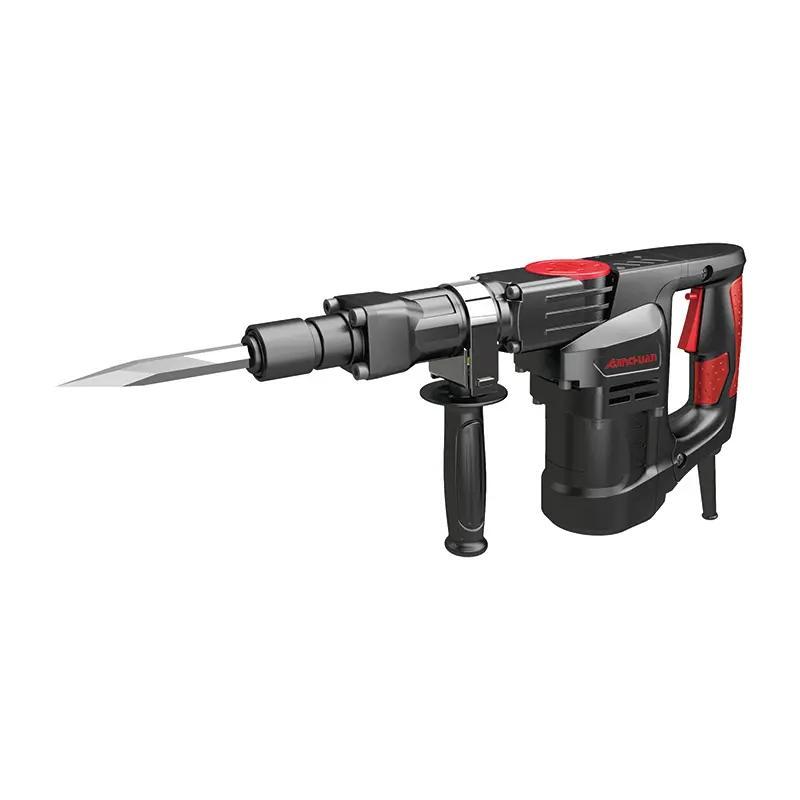
The core advantage of hexagonal demolition hammers lies in their hexagonal drive structure. This connection method provides tighter engagement than the standard round-handle design of conventional hammers, reducing impact energy loss and enabling more direct power transmission to the drill bit. Simultaneously, the hexagonal structure ensures precise positioning, preventing drill bit deviation and slippage during operation—making it particularly suited for high-strength concrete demolition.
During an old building renovation project, a construction crew initially used standard round-shank hammers to demolish concrete walls, achieving only 8m² of removal per day. After switching to heavy-duty hex demolition hammers under identical conditions, daily removal increased to 13m²—a 40% efficiency boost with no drill bit slippage issues.
Some buyers question: Do hex demolition hammers require specialized drill bits? In fact, most models support standard hex drill bits, and some can even accommodate certain round-shank bits via adapters. However, note that adapters may slightly reduce impact efficiency—prioritize using original hex drill bits.
Vibration Control Design: How to Reduce Long-Term Demolition Workload?
Concrete demolition involves high-intensity, prolonged operations where vibration levels directly impact operator comfort and equipment lifespan. Hex demolition hammers typically feature dual vibration reduction systems—combining body damping handles with internal buffering structures—effectively minimizing vibration transmission.
One construction company experienced multiple wrist strain injuries among workers using standard electric hammers for concrete demolition, alongside frequent equipment failures due to excessive vibration. After switching to hexagonal demolition hammers with vibration damping, workers could extend their operating time by 2 hours, and equipment failure rates decreased by 65%.
Common Question: Does superior vibration damping compromise impact power?
No. High-quality products achieve a balance between vibration reduction and power output. By optimizing internal structures to disperse vibrations rather than weakening impact energy, core impact power remains more stable than in standard electric hammers.
Durability: How does it withstand harsh concrete demolition conditions?
During concrete demolition, equipment endures intense impacts and dust erosion. Hex demolition hammers prioritize durability through material selection and sealing design. Their bodies typically use high-grade alloy steel, while internal bearings feature sealed protection to prevent dust from entering wear components.
A cross-border procurement company supplying tools to overseas construction teams initially chose standard electric hammers. Dust ingress caused a 30% bearing failure rate, significantly increasing after-sales costs. After switching to sealed hex demolition hammers, the bearing failure rate dropped below 5%, making them suitable for dust-intensive construction environments.
Common user question: Does the motor of hex demolition hammers overheat during prolonged demolition of hard foundations?
Select models with overheat protection and forced cooling systems. These prevent overheating during continuous operation under 2 hours and cool rapidly within 10 minutes of shutdown.
Load adaptation capability: How to handle concrete demolition of varying strengths?
Concrete strength varies significantly across scenarios. The hexagonal demolition hammer’s load adjustment function offers greater flexibility, allowing impact settings to be switched based on concrete hardness. It adapts to tasks ranging from light wall demolition to heavy foundation breaking, offering far greater compatibility than standard electric hammers.
A municipal maintenance team encountered varying strengths of road base layers while breaking pavement concrete. Standard electric hammers either lacked sufficient power to break through or were too powerful, damaging the base layer. After switching to a multi-speed hex demolition hammer, they adjusted settings as needed, ensuring efficient demolition while protecting the base structure.
Buyer’s Question: For small-scale home concrete demolition, isn’t a hex demolition hammer too bulky?
Lightweight models are available, weighing under 8kg. They suit home renovations and minor repairs, balancing power and portability—more practical than large equipment.
FAQ: Frequently Asked Questions
1. What’s the core difference between a hex demolition hammer and a standard electric hammer?
The core difference lies in drive structure and load capacity. The hex design delivers more efficient power transfer, precise positioning, superior vibration damping, and enhanced durability—making it ideal for concrete demolition. Standard electric hammers are better suited for drilling and light breaking tasks.
2. What parameters should I focus on when selecting a tool for concrete demolition?
Prioritize impact power (≥1500W recommended), weight (10-15kg for construction sites, under 8kg for home use), and vibration damping. Choose models with overheat protection and sealed bearings.
3. Is maintenance cost higher for hex demolition hammers than regular electric hammers?
Initial purchase costs are slightly higher, but their superior durability and lower failure rates result in lower long-term maintenance expenses. Regular bit cleaning and lubricant replacement suffice to extend service life.
Concrete demolition demands exceptional power, stability, and durability from power tools. Hex demolition hammers are gradually replacing standard hammers as the mainstream choice due to their structural advantages and suitability for such conditions. For buyers, selecting the right hex demolition hammer helps end-users boost construction efficiency while reducing operational strain and equipment wear—the core value proposition of this tool.
Meta Description: Hex-style demolition hammers outperform standard electric hammers in concrete demolition. This article analyzes their structural advantages, vibration control, and application techniques, complemented by real-world construction case studies. Empower cross-border buyers and construction teams to make precise selections—access the professional purchasing guide now.
Keywords: Hex-style demolition hammer, concrete demolition power tools, heavy-duty hex demolition hammer, hex demolition hammer selection techniques
Post time: Jan-28-2026