
In the mold workshop, the grinding process is often regarded as a crucial “watershed”. It lies between rough cutting and fine polishing. Especially when dealing with tough die steels like P20, H13, and S136, the tools and skills in the operator’s hands directly determine the fate of the die surface. Here, the 180mm professional Angle grinder, with its unique balance – combining sufficient material removal force with relative controllability – has become the first choice for many experienced workers. But to control this “beast” and achieve precise effects is far from as simple as pressing a switch. It is a comprehensive test of control.
Understanding Tool: Why 180mm?
First of all, it should be understood that choosing an 180mm Angle grinder in the context of die steel grinding is a trade-off between efficiency and controllability. Compared with smaller 125mm or 150mm specifications, 180mm grinding wheels have a greater linear speed and contact area. They have obvious advantages when leveling large surfaces or removing thicker allowances, and can effectively improve the efficiency of rough grinding and semi-fine grinding stages. Compared with Angle grinders of 230mm or even larger, its weight and torque are relatively mild. For experienced operators, there is still hope to achieve surprising precision control through skills. It is like a heavy sword. Though not as agile as a short sword, in the hands of a master, it can handle heavy loads with ease.
The cornerstone of precision: Preparatory work is far more important than imagined
Precision control has already begun before starting the machine.
The selection of grinding wheels is the primary decision. When dealing with die steels of different hardness and conditions, the matching of grinding wheel material and grain size is of vital importance. For the removal of tool marks and deburring of conventional die steel, fiber-reinforced resin cutting discs or cymbal grinding wheels are common choices. However, if higher surface consistency is to be pursued, especially in preparation for subsequent polishing, many people tend to choose multi-layer fiber-reinforced grinding discs. This type of grinding wheel has better flatness when rotating at high speed, is less likely to wobble, and the abrasive grains fall off more evenly, which can effectively reduce the “jumping tool” marks. For steels with particularly high hardness, such as quenched molds, it is necessary to choose ceramic alumina grinding wheels or cubic boron nitride (CBN) grinding wheels specially designed for this purpose. Ordinary grinding wheels are not only inefficient but also will lose accuracy due to rapid wear.
The stability check of tools is a silent ritual. After installing the grinding wheel, the vibration sensation when lightly touching the machine body under no-load conditions and the smoothness of the sound when starting to full speed operation are both intuitive bases for judging the tool status, whether the clamping is in place, and whether there is potential wobbling of the spindle. A tiny jump, at high speed, will be magnified into an irreparable flutter mark on the workpiece surface.
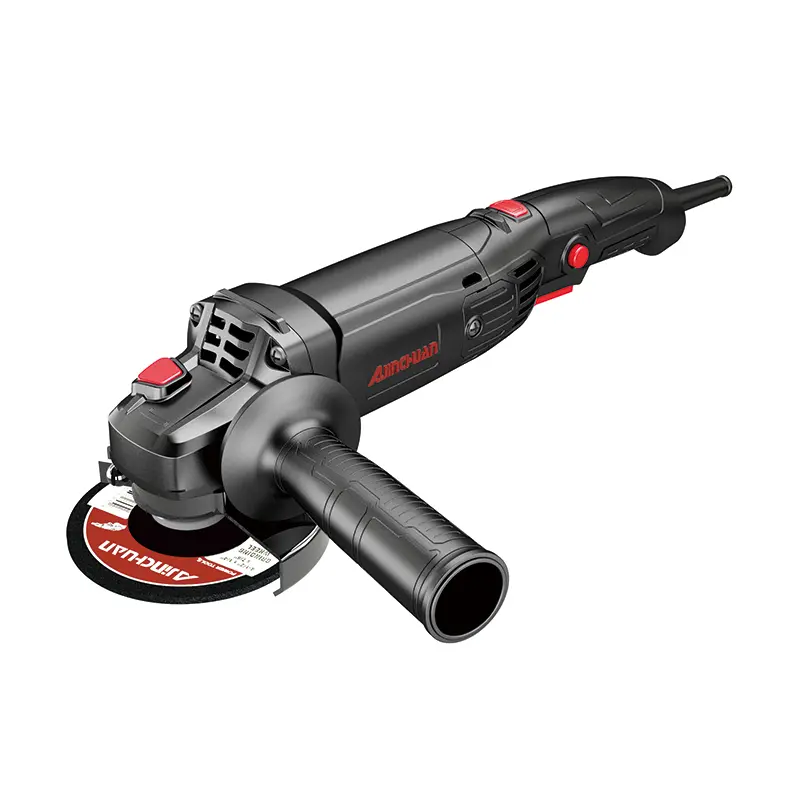
The core of control: posture, trajectory and sense of rhythm
True precision is born in the dynamic interaction between people and tools.
A stable posture is the foundation. Polishing does not rely on the strength of the arms to “press”, but rather on the stability of the entire body to “guide”. Stand with your feet apart front and back, slightly bend your knees, and transfer the weight and reaction force of the tool to the ground through your body. Two-hand grip: The rear hand mainly provides thrust and direction control, while the front hand is more like a stable guiding fulcrum, especially when using the auxiliary side handle. Remember, let the weight of the machine itself and the recoil force during operation be part of the stabilizing system, rather than the object of confrontation.
The movement trajectory determines the surface texture. The most undesirable thing is to stay in one position for a long time or polish back and forth randomly, as this can easily cause local overheating annealing or the formation of pits of varying depths. The ideal trajectory is uniform, linear and overlapping movement. Smoothly advance along one direction of the mold cavity or plane, with each stroke path overlapping approximately one-third of the previous one, ensuring that the material is evenly removed. For curved surfaces, it is necessary to follow the direction of the contour, just like “stroking” the surface with a grinding wheel, keeping the tangential direction of the contact point stable.
Feeding temperature management is a delicate rhythm. The Angle grinder is a powerful heat source. On die steel, especially after heat treatment, local overheating is a hidden killer of precision and material performance. It will lead to a decrease in hardness and even cause microcracks. Therefore, light touch, quick walk and frequent movement are unbreakable rules. Don’t try to grind off a large amount of material at one time. Instead, gradually achieve the goal through multiple uniform light grinding sessions. When the workpiece feels significantly hot, it must be stopped to cool down. Using an Angle grinder with speed regulation function has advantages here. During the fine dressing stage, appropriately reducing the rotational speed can effectively reduce heat input and enhance controllability.
The elevation of precision: Assistance and perception
After mastering the basic control, some advanced techniques and auxiliary tools can push the precision to a higher level.
Make use of the guide plate and the backing. For grinding that requires ensuring a specific Angle or plane, making or using a simple metal or hardwood guide plate, holding or fixing it beside the workpiece, and allowing the bottom plate of the Angle grinder or the edge of the grinding wheel to slide along it can greatly improve the straightness and Angle accuracy of the grinding.
Cultivate the perception ability of “listening” and “seeing”. The sound made during grinding is an important feedback. Uniform and smooth grinding sounds usually indicate good contact and feed. A shrill or intermittent sound may indicate that the grinding wheel is blurry, the feed is too fast or the Angle is inappropriate. Meanwhile, observe the state of the spark. Long and continuous orange-red spark flows often indicate a relatively high feed pressure and a high removal rate. Short and dense bright white sparks may indicate that the grinding wheel is too sharp or the contact is too light. Experienced operators can initially judge the approximate hardness and grinding condition of steel by the color and shape of the sparks.
The ingenious use of lighting and marking. Before grinding, color the area to be processed with a marker pen (such as an electrical work pen), and the process where the color is evenly ground off during grinding is the most intuitive “de-measurement indicator”. At the same time, by using a movable high-intensity work light to illuminate the ground surface at a low Angle, any uneven scratches and pits can be clearly highlighted. This is the golden rule of visual inspection.
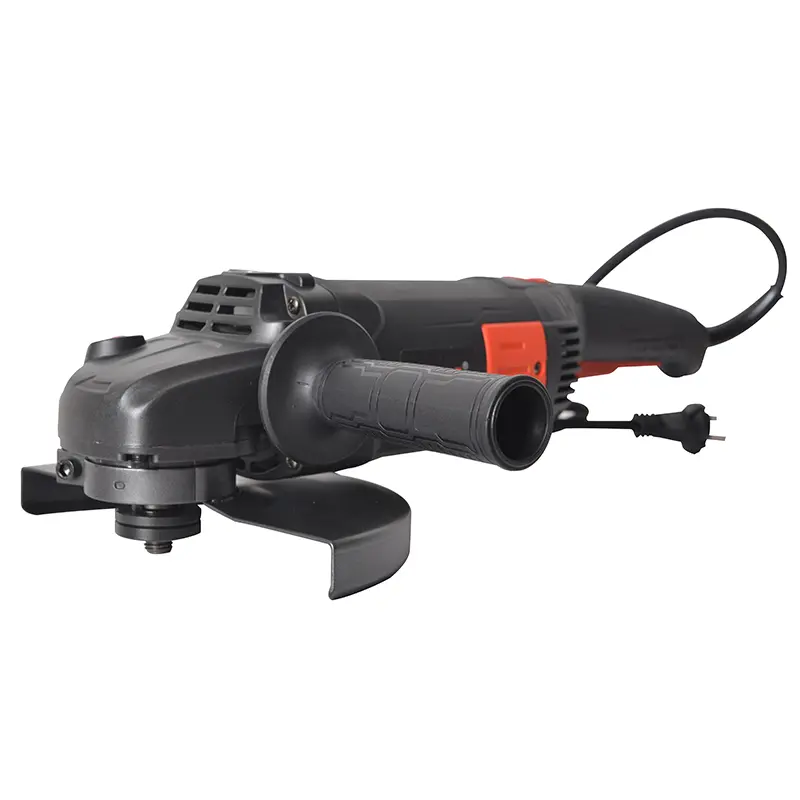
Safety: The prerequisite for all precision
Finally, it must be restated that any discussion about precision is based on absolute security. Facing the powerful energy generated by the 180mm Angle grinder on the die steel, being fully equipped – including goggles, cut-resistant gloves, earplugs and sturdy work clothes – is a mandatory requirement. Make sure the workpiece is firmly clamped on the bench vise or worktable, the grinding direction is away from the human body, and always remain vigilant about the condition of the tool and the surrounding environment.
In conclusion, precision grinding of die steel with an 180mm Angle grinder is a process of applying a tool originally designed for rough machining to the precision field through ultimate skills and understanding. It tests not only the operator’s manual skills, but also a profound understanding of the characteristics of materials and tools as well as physical processes. Every smooth movement and every evenly removed piece of material silently proves that precision is never the exclusive domain of precision machine tools; it also exists in the hands of those who know how to dance with strength.
Post time: Dec-04-2025