
Hexagonal Demolition Hammer: Application in Secondary Crushing After Mine Blasting
The application of hexagonal demolition hammers in secondary crushing after mine blasting is a core demand for many cross-border buyers, mine equipment wholesalers, and end-user mine practitioners. However, it is also a common area for mistakes—choosing the wrong model leads to low crushing efficiency, rapid equipment wear, and even safety hazards due to poor adaptability, which wastes procurement costs and delays mine construction progress.
From a practical perspective, this article details the application skills, selection methods, and maintenance points of hexagonal demolition hammers in mine secondary crushing, helping buyers choose the right products, wholesalers improve repurchase rates, and end-users use the equipment efficiently and worry-free. Next, we will start with the core pain points of mine secondary crushing and share practical insights step by step.
Why Are Hexagonal Demolition Hammers Suitable for Mine Secondary Crushing? (Dual Advantages: Efficiency & Durability)
Many buyers and mine practitioners often ask: with so many crushing equipment on the market, why are hexagonal demolition hammers more suitable for secondary crushing after mine blasting? The answer is simple: the scenario of mine secondary crushing is special, requiring high impact force, durability, and adaptability from the equipment—and hexagonal demolition hammers precisely meet these needs.
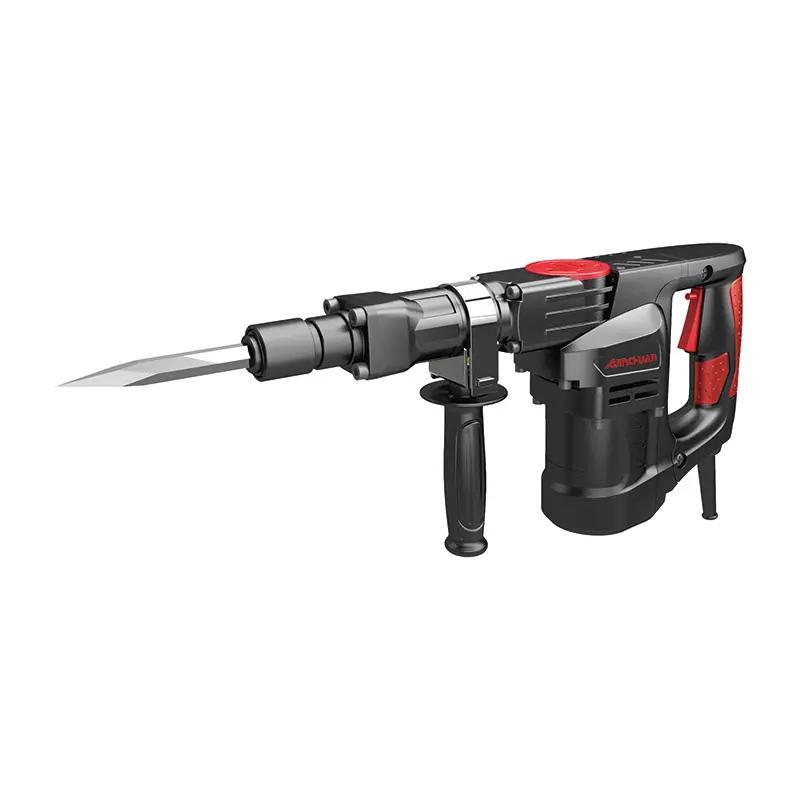
The core advantage of hexagonal demolition hammers lies in their hexagonal chuck design. Compared with ordinary round chucks, the hexagonal chuck provides a more stable grip, which is less likely to cause drill bit slipping or falling off. It is especially suitable for crushing irregular large rocks after mine blasting, greatly improving safety.
Moreover, high-quality hexagonal demolition hammers can reach an impact frequency of 2000 BPM and a maximum impact energy of 50J. The concentrated impact force can quickly break large residual rocks after blasting, improving efficiency by more than 30% compared with ordinary hydraulic breakers and significantly shortening the construction cycle.
Here’s a real case: We once cooperated with a cross-border buyer specializing in mine equipment, who mainly supplied European mines. Initially, he purchased a batch of ordinary round chuck hydraulic breakers for secondary crushing operations.
However, the end-user mines reported frequent drill bit slipping, low crushing efficiency—only 80 cubic meters of crushing volume per day—and rapid wear of vulnerable parts, which needed to be replaced every 3 days, leading to constant after-sales complaints. Later, we suggested he switch to hexagonal demolition hammers, which are suitable for the high-intensity working conditions of mine secondary crushing.
After the replacement, the crushing efficiency of the end-user mines directly increased to 150 cubic meters per day, the replacement cycle of vulnerable parts extended to 7 days, the after-sales complaint rate dropped by 80%, and the buyer’s repurchase rate also increased by 25%.
Some buyers may ask: “Mine rocks have different hardness levels. Can hexagonal demolition hammers adapt to all rock hardnesses?” There is no need to worry too much. Hexagonal demolition hammers come in different power models. For medium to high-hardness rocks common in mines, such as basalt and granite, choosing a model with power above 1700W and impact energy ≥40J can easily handle the task. You can flexibly select the model according to the rock hardness of the end-user mine when purchasing.
Practical Operation Process of Hexagonal Demolition Hammers for Mine Secondary Crushing (Easy for Beginners)
Many end-users feedback that even if they buy the right hexagonal demolition hammer, improper operation leads to low efficiency and rapid equipment wear. In fact, as long as you master the correct operation process, even beginners can quickly get started and maximize the equipment’s performance.
Step 1: Pre-operation inspection. Focus on checking whether the hexagonal chuck is tight, whether the drill bit is worn, and whether the equipment lines are intact. Especially in mines with high dust, clean the dust in the chuck to avoid affecting the clamping stability. At the same time, check the equipment lubrication to ensure smooth operation.
Step 2: Locate the crushing point. For large rocks after mine blasting, select the weak points of the rock (such as cracks and edges) as the crushing point, and avoid hitting the rock surface vertically. This can not only improve crushing efficiency but also reduce drill bit wear.
Step 3: Standard operation. After starting the equipment, keep the drill bit perpendicular to the crushing point and apply pressure slowly. Avoid excessive force, which will cause excessive equipment vibration and damage the motor. At the same time, operators must wear protective equipment to prevent flying gravel from injuring people.
Share a case of an end-user mine: A small iron mine purchased a hexagonal demolition hammer, but because the operators did not master the correct process, they kept hitting the rock surface vertically. This not only resulted in low crushing efficiency but also frequent drill bit damage, increasing the monthly wear cost by nearly 1,000 RMB.
We sent technicians to provide on-site guidance, teaching them to locate weak points and standardize the operation process. After the adjustment, the crushing efficiency increased by 40%, the monthly drill bit wear cost decreased by 60%, and the operators also reported that the equipment vibration was reduced and the operation was easier.
End-users often ask: “Mines have high dust. How to prevent dust from entering the equipment and damaging the motor after long-term operation?” It is actually very simple: use a small dust removal equipment during operation, clean the dust on the equipment surface and inside the chuck in a timely manner after operation, and regularly check the equipment sealing to ensure it is intact. This can effectively protect the motor and extend the equipment service life.
Procurement Pitfall Avoidance: Choose the Right Hexagonal Demolition Hammer to Reduce Mine Operation Costs
For cross-border buyers and wholesalers, choosing the right hexagonal demolition hammer can not only improve end-user satisfaction but also reduce after-sales costs and increase repurchase rates. Many procurement mistakes are caused by failing to grasp the core selection points and stepping into common industry pitfalls.
First, select the model according to the working conditions of the end-user mine. For example, for small mines with low crushing volume, choose a portable model with 1500-1700W power and light weight (10-15kg) for easy movement; for large mines with high crushing volume, choose a heavy-duty model with power above 1700W and impact energy ≥50J to improve efficiency.
Second, pay attention to equipment materials and core components. The cylinder block of high-quality hexagonal demolition hammers is made of high-chromium alloy, which is wear-resistant and impact-resistant; the motor is a full-copper motor with good heat dissipation and is not easy to burn out. Vulnerable parts (drill bits, seals) should be made of wear-resistant materials to reduce replacement frequency.
In addition, cross-border procurement must pay attention to compliance certifications. Hexagonal demolition hammers exported to Europe must have CE certification, including LVD (Low Voltage Directive) and EMC (Electromagnetic Compatibility Directive), to ensure compliance with local safety and environmental standards and avoid customs detention.
Here’s a real case: A cross-border buyer initially purchased a batch of hexagonal demolition hammers without CE certification and of poor quality to save costs. When exported to Europe, the goods were detained by customs, resulting in not only the loss of goods costs but also delayed delivery, with a direct loss of more than 100,000 RMB.
Later, he cooperated with a supplier with formal qualifications, purchasing hexagonal demolition hammers with CE certification, up-to-standard materials and craftsmanship. He conducted small-batch trial orders before bulk procurement, and there were no more compliance issues. The after-sales rate was also controlled below 3%.
Some buyers may ask: “There are many brands of hexagonal demolition hammers on the market. How to distinguish high-quality products from inferior ones?” It is actually very simple: first, ask the supplier to provide material test reports and compliance certifications; second, conduct small-batch trial orders to test the impact force and stability of the equipment; third, check the brand of core components, and give priority to products using well-known brand motors and chucks.
Daily Maintenance Tips for Hexagonal Demolition Hammers (Extend Service Life, Reduce After-Sales)
The mine operation environment is harsh, with high dust and strong vibration. The daily maintenance of hexagonal demolition hammers directly affects the equipment service life and operation efficiency, which is also the most concerned issue for end-users. Doing the following points can greatly extend the equipment service life and reduce after-sales disputes.
First, regular lubrication. Before daily operation, apply grease to the connection between the hexagonal chuck and the drill bit; add lubricating oil to the internal transmission components of the equipment every week to avoid component wear and ensure smooth operation. This is the most basic and critical step.
Second, timely replacement of vulnerable parts. When the drill bit is worn or cracked, replace it in a timely manner to avoid wearing the chuck; when the seal is aged or leaking, replace it in a timely manner to prevent dust and moisture from entering the equipment, damaging the motor and cylinder block.
Third, standardized storage. After operation, clean the equipment and store it in a dry and ventilated place to avoid motor dampness and cylinder block rust caused by a humid environment. Especially for open-pit mine operations, take rainproof and dustproof measures when storing.
We once cooperated with a large mine that initially ignored equipment maintenance, resulting in an average service life of only 8 months for hexagonal demolition hammers and high after-sales costs. Later, we formulated a simple and easy-to-understand maintenance manual to guide them in daily maintenance.
After the adjustment, the average service life of the equipment extended to 18 months, and the after-sales cost dropped by 70%. This not only saved the cost of equipment replacement but also reduced construction stagnation caused by equipment failures, indirectly improving the mine’s operational efficiency.
Some end-users may ask: “What should I do if the motor of the hexagonal demolition hammer overheats?” Most of the time, it is due to long-term continuous operation or dust blocking the heat dissipation port. At this time, stop the equipment immediately, clean the dust from the heat dissipation port, and let the motor cool naturally. Avoid forced operation, which will cause the motor to burn out.
FAQ — Frequently Asked Questions
Q1: What is the core difference between hexagonal demolition hammers and ordinary round chuck hydraulic breakers? A1: The core difference lies in the chuck design. The hexagonal chuck provides a more stable grip, which is less likely to slip or fall off, making it suitable for irregular rocks in mine secondary crushing with higher safety and efficiency. The ordinary round chuck is prone to slipping, suitable for light crushing, and not suitable for high-intensity mine working conditions.
Q2: For cross-border procurement of hexagonal demolition hammers, what else should be paid attention to besides CE certification? A2: Exports to the United States need to comply with UL certification, and exports to the United Kingdom need to apply for UKCA certification separately. At the same time, clearly mark product parameters, usage instructions, and safety warnings, and ensure that the packaging meets the transportation standards of the target market to avoid damage.
Q3: For mine secondary crushing, how often should the vulnerable parts of hexagonal demolition hammers be replaced? A3: It depends on the operation frequency and rock hardness. Under normal operation, the drill bit should be replaced 1-2 times a month, and the seal should be replaced every 3 months. If the operation intensity is high and the rock hardness is high, the replacement cycle can be appropriately shortened. Regular inspection and timely replacement are more worry-free.
Meta Description
Detailed application skills, selection methods, and daily maintenance tips of hexagonal demolition hammers in secondary crushing after mine blasting. Combined with real industry cases, it provides practical guides for cross-border buyers, wholesalers, and B2B customers to avoid procurement mistakes, improve operation efficiency, and reduce operation costs. Professional power tool practitioners share practical insights, highlighting the efficiency and durability advantages of hexagonal demolition hammers, which are suitable for complex mine working conditions and compliant with standards. Welcome to consult high-quality hexagonal demolition hammer procurement solutions.
Core Keywords
hexagonal demolition hammer, mine secondary crushing, cross-border purchase hexagonal demolition hammer, hexagonal demolition hammer selection skills, mine crushing tool maintenance methods, hexagonal demolition hammer CE certification
Post time: Mar-05-2026