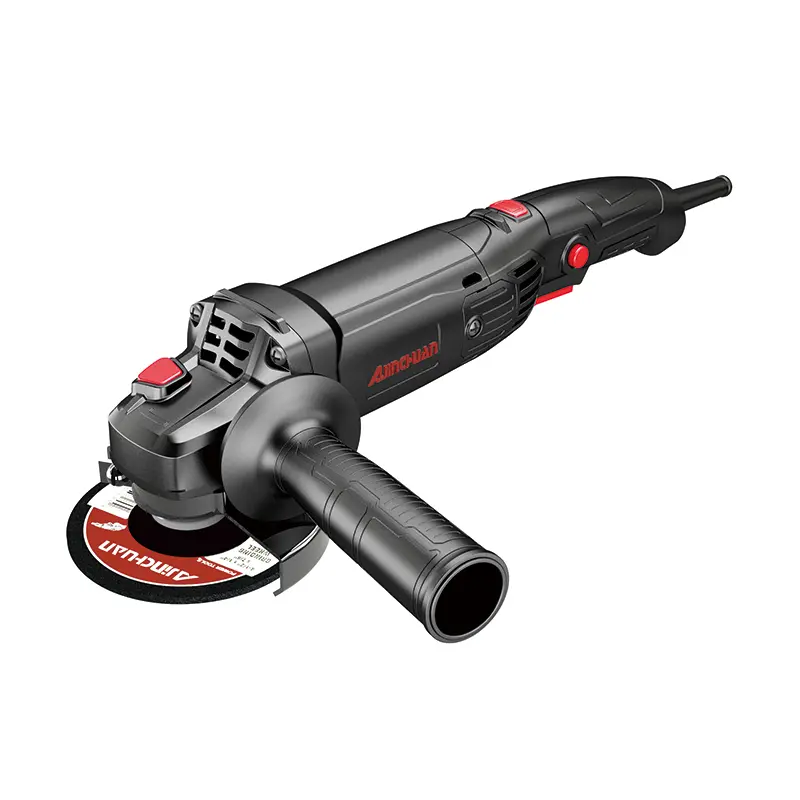
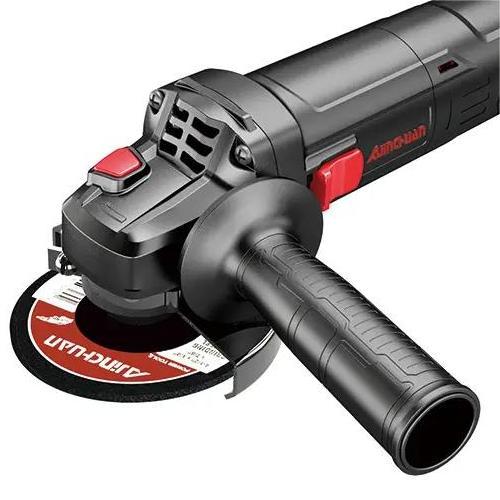
Cable Length Design of Light Angle Grinders: Flexibility for Mobile Operations
On an afternoon construction site, an electrician finishes cutting the last pipeline on a 3-meter ladder, sighs with relief, and gets ready to adjust the angle for grinding. He habitually pulls the angle grinder back, but the machine moves less than half a meter— the mere 2-meter power cord is stretched to its limit, pinning him firmly in place. To continue working, he has to climb down the ladder, find a new spot, and plug into a mobile socket.
For professional users who work with angle grinders every day, cable length is far from an irrelevant parameter. It directly determines work efficiency, job safety, and even the daily work load. However, a large number of
light angle grinders marketed as “lightweight” and “high-efficiency” on the market are equipped with embarrassingly short power cords, forcing workers to plug and unplug repeatedly or use extension cords with potential safety hazards—this completely goes against the original intention of “mobile operation”.
From the mixed perspective of a senior product manager and an end-user, this article analyzes the engineering trade-offs and real user needs behind the cable length design of light angle grinders. We will not talk about empty theories, but focus on how to find the best balance between safety, cost, portability, and operational flexibility, helping buyers select truly user-friendly tools for end-users.
01 The Trap of Standards: Why Has the “3-Meter Cable” Become an Industry Convention?
If you disassemble ten light angle grinders of different brands (usually 100mm-125mm disc diameter), about seven or eight will be equipped with a 3-meter H05VV-F or H07RN-F specification rubber cable. This has seemingly become an unspoken industry standard. But where did this standard come from?
The primary reason is the inherent restrictions of global mainstream safety certification systems. Take the common IEC/EN 60745 hand-held tool standard as an example: it has strict regulations on the mechanical strength, insulation resistance, oil and heat resistance of cables, but does not mandate a specific length. However, certification laboratories use standard-length test cables for temperature rise and durability testing. Once a manufacturer certifies a model with a specific cable length, arbitrarily extending it may affect the compliance of test results, bringing risks and costs of recertification. Therefore, many brands tend to adopt the most stable, repeatedly verified “standard length”.
The second reason is the hidden pressure of cost and packaging. Every additional meter of 16AWG rubber cable means higher direct material costs, larger cable reel volume leading to changes in packaging box size, and further impacts the number of containers shipped. For mass-market, low-cost products, cost control of every cent and logistics optimization of every cubic centimeter are crucial. A real case: a European brand once planned to launch a 5-meter cable angle grinder for the Asian market, but the project was eventually stranded due to a nearly 5% increase in estimated sea freight costs caused by the larger single-box packaging volume.
A common question from buyers: “Can we directly ask the factory to make the cable 5 meters or even longer?” Of course, but this is by no means a simple “extending the cable”. Extending the cable will increase the overall voltage drop, which may cause insufficient voltage at the motor input under high load, affecting power output and even leading to motor overheating. This requires engineers to re-evaluate the motor design, adjust the winding, or replace with a thicker wire gauge (e.g., upgrading from 18AWG to 16AWG), which is essentially developing a new derivative model.
02 The Cost of Flexibility: Three Major Hidden Dangers of Excessively Long Cables
Since users crave longer cables, why don’t factories make them longer? Because a cable is never the longer the better; unconstrained extension introduces new, sometimes more dangerous problems.
The first and foremost is the safety risk at the job site. Loose cables longer than 5 meters spread across the work area are easily cut by falling metal debris, sharp workpiece edges, or tripped by other workers or vehicles, causing the tool to be pulled out of the hand. In metal processing workshops, there have been dangerous incidents where an excessively long cable got caught in a mobile sawing machine, causing the angle grinder to fly off an aerial work platform. Safety specifications clearly recommend that cables be suspended or fixed along the wall to avoid laying on the ground, which is almost impossible in mobile operations.
The second is a sharp decline in the portability and storage experience of the tool itself. Imagine a light angle grinder that is compact in size but dragging a thick, heavy, hard-to-manage “long tail”. When workers move between different workstations, they either spend time awkwardly winding the cable or let the cable drag and wear. This seriously weakens the core advantage of “lightweight” tools. Our user tracking data shows that tools with cables longer than 5 meters have a cable damage rate (plug rupture, skin wear) about 40% higher than those with 3-meter cables.
The last is the technical reality of voltage drop and power loss. According to simple formula calculations, using a standard 0.75mm² cross-sectional area cable, when the length increases from 3 meters to 10 meters, the voltage drop at the end of the line may exceed 5 volts when operating at a rated input power of 1000W. This will make the tool “weak” when cutting high-hardness materials, 加剧 motor heating, and affect its service life in the long run. To compensate for this loss, either increase the wire diameter (increasing cost and weight) or reserve motor performance margin for longer lines during the design phase.
03 Finding the Golden Balance: 4-4.5 Meters May Be the “Flexibility Sweet Spot”
Based on extensive on-site observations and user feedback analysis, we believe that for light angle grinders used in most indoor and outdoor comprehensive working conditions, a cable length of 4 to 4.5 meters may be a better “flexibility sweet spot”.
This length range cleverly balances contradictions. Compared with the standard 3-meter cable, it increases the working radius by 33%-50%, allowing workers to cover all walls from a corner socket in a standard room (with a diagonal length usually exceeding 5 meters) without changing sockets halfway. At the same time, this length has not yet reached the critical point requiring special attention to safety management and significant voltage drop.
A case from a German professional tool distributor is very persuasive. Their customized
angle grinders launched for building maintenance teams are uniformly equipped with 4.2-meter cables. Their research found that this length is sufficient for workers to handle wall problems on the upper and lower half floors from a middle platform socket in a standard floor height stairwell. This product has thus become a standard for maintenance teams with an extremely high repurchase rate. The key to its success is precisely the precise definition of the core users’ high-frequency usage scenarios and the customized cable length for them.
Achieving this design requires advance planning in the product definition phase. It requires engineers to take “full-load temperature rise under a 4.5-meter cable” as the design input, rather than a remedy after the fact. This may mean choosing copper materials with slightly better electrical conductivity, optimizing motor magnetic circuit efficiency, or using 0.85mm² cables if cost permits. This is a systematic project.
A common question from buyers: “Do the grid voltages of different countries (110V/230V) affect the selection of cable length?” The impact is significant. Under the same power, the operating current of a 110V system is about twice that of a 230V system, generating greater voltage drop and heat on the cable. Therefore, angle grinders designed for 110V markets such as North America must use thicker wire diameters (e.g., 14AWG instead of 16AWG) to ensure safety and performance when designing longer cables, with a more obvious increase in cost.
04 Beyond Length: Other Key Dimensions of Cable Design
When we discuss “cable length design”, we must not only focus on the numbers on the ruler. The material, structure, and detail processing of the cable are equally important.
Cable material is the cornerstone of durability. High-quality neoprene outer sheaths are more resistant to oil, sun, and cold cracking than ordinary polyvinyl chloride (PVC) cables. In cold Nordic construction sites, PVC cables become as stiff as sticks at minus ten degrees Celsius, seriously affecting operation, while rubber cables can still maintain a certain flexibility. During procurement, you can ask suppliers to provide details of UL or VDE certifications for cables, focusing on their temperature resistance grade (e.g., -25°C to +60°C) and oil resistance grade.
The protection grade and structural strength of the plug are a severely underestimated link. A plug with splash-proof design (IP44 or above) can effectively prevent short circuits caused by cement slurry and water mist intrusion on the construction site. The “cable gland” or stress relief structure at the tail of the plug is crucial, as it can prevent premature breakage at the frequent bending point (plug connection). Many damage to cheap tool cables starts here.
For bulk buyers with special needs, a detachable cable design is a high-value option. Although this increases the cost of connectors (e.g., using industrial-grade IEC 60320 C13/C14 couplers), it brings great flexibility: cables can be replaced separately after damage; 3-meter short cables and 10-meter long cables can be quickly switched according to the daily operation range; different power cords can even be prepared for different voltage regions. This is particularly suitable for standardized management of tool rental companies or large construction enterprises.
05 Action Checklist for Buyers: How to Select the Right Product for Your Customers?
As a buyer, your choices directly affect the end-user experience and your brand reputation. When evaluating the cable configuration of light angle grinders, please include the following questions in your supplier evaluation list:
-
Question the design logic: Do not only accept the statement of “industry standard”. Directly ask: “What is the typical usage scenario preset for this angle grinder? Why was this specific cable length and specification chosen for it?” An excellent product manager should be able to answer this question clearly.
-
Request key certifications: Ask to see the separate safety certification certificates for the cable and plug (e.g., VDE, UL, CSA), and confirm that their specifications (wire diameter, temperature resistance, oil resistance) match the rated power and environmental grade of the whole machine.
-
Conduct on-site simulation tests: During the sample testing phase, find a site simulating a construction site environment for workers to use realistically. Focus on: Is the cable easy to wind and store? Is the plug connection firm when pulled? Is the actual working radius sufficient?
-
Consider customized options: For capable buyers, discuss the possibility of custom cable lengths with the factory. Understand the minimum order quantity, cost increase, and required certification cycle. Sometimes, a unique, more user-friendly configuration is the key selling point that makes your product stand out in the market.
A common question from buyers: “If end-users generally report that the cable is not long enough, can we recommend them to use extension cords?” This is an emergency solution, but by no means the best option. You should clearly inform users that when using extension cords, they must choose industrial products with the same high protection grade and sufficient wire diameter, and ensure a firm connection and placement in a dry and safe place. A better solution is for you, as a buyer, to actively find or customize models with longer cables to provide a one-stop solution for users.
Back to the scene at the beginning of the article. If the
light angle grinder in the electrician’s hand was equipped with a carefully designed 4.2-meter high-quality cable, everything would be different: he could calmly complete a series of actions such as cutting, grinding, and cleaning on the ladder without interrupting his flow state halfway. The cable had enough margin to avoid tension, reducing safety risks. After using the tool, he could quickly and neatly wind the cable and easily move to the next work point.
This is the value of excellent industrial design—it silently integrates into the work process, improves efficiency, ensures safety, and reduces fatigue. The cable length design of light angle grinders, a seemingly tiny detail, is exactly the key to distinguishing a tool that is “just usable” from one that is “truly user-friendly”. As the lifeline connecting energy to work, it deserves more attention and consideration from every product designer, buyer, and user.
FAQ: Common Questions About Light Angle Grinder Cable Design
Q1: Does a cordless angle grinder mean completely getting rid of the trouble of cable length?
Cordless angle grinders offer ultimate freedom of movement, but they bring new trade-offs: battery weight, continuous power, single-use time, and purchase cost. For all-weather, high-intensity continuous grinding operations, current corded models still have advantages in power continuity and comprehensive cost. Cables and batteries are solutions for different scenarios, not a simple alternative relationship.
Q2: What do the markings like “H07RN-F 3G 0.75mm²” on the cable outer sheath mean?
These are common European cable specification markings. H07RN-F indicates the cable type (H – harmonized standard, 07 – 450/750V voltage level, RN – rubber insulation and sheath, F – flexible); 3G indicates three-core wires (live wire, neutral wire, ground wire); 0.75mm² is the cross-sectional area of each conductor, which directly affects the current-carrying capacity. During procurement, you should ensure clear markings and specifications matching the tool power.
Q3: If the cable is accidentally damaged, can the user cut and repair it by themselves?
Strongly not recommended. Non-professional connections may cause increased resistance, heating, poor insulation, or wrong phase connection, leading to serious electric shock or fire risks. The correct approach is to contact the manufacturer or a professional maintenance point to replace the entire original cable, or have a professional electrician repair it with standard connectors. Safety specifications usually prohibit permanent splicing on the main cable of hand-held tools.
Meta Description
When purchasing a light angle grinder, have you overlooked the key detail of cable length? This article deeply analyzes the origin of the industry-standard cable length, reveals the safety hazards of excessively long cables, and proposes the 4-4.5-meter “flexibility sweet spot” concept, helping buyers select truly user-friendly tools that balance safety, efficiency, and cost for end-users based on real work scenarios.
Keywords
light angle grinder cable length design, power tool mobility flexibility for mobile operations, angle grinder power cord safety standards, industrial angle grinder procurement guide, tool cable specifications and durability