
Application of 80mm Small Angle Grinder in Edge Treatment of Handmade Leather Goods
Opening Introduction
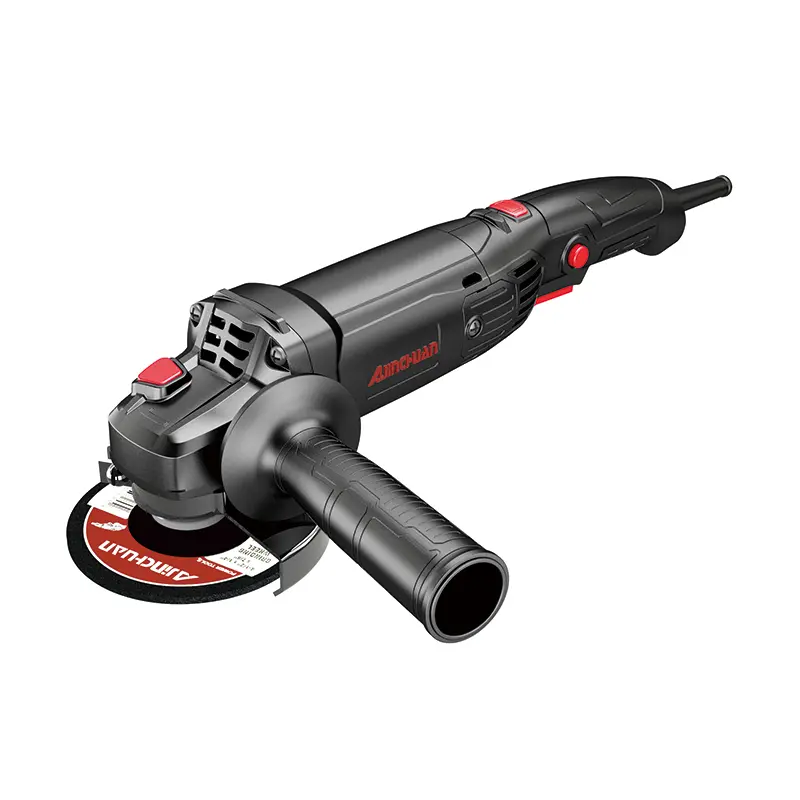
In the high-end customization field of handmade leather goods, the fineness of edge treatment often directly determines the final selling price of the product and the brand reputation. However, traditional manual edge trimming and polishing are inefficient, making it difficult to cope with the delivery pressure of bulk orders. Many workshop owners thus fall into a dilemma: either sacrifice precision for speed, or lose customer trust due to delayed construction periods. This article will deeply explore the application of 80mm small angle grinder in edge treatment of handmade leather goods, revealing how to transform industrial-grade power tools into sharp tools for leather making through professional modification and practical skills. It will help you double production efficiency while maintaining the handmade texture, easily undertaking large-scale B-end orders.
1. Core of Tool Selection and Modification: How to Balance Rotational Speed, Torque and the Delicacy of Leather Polishing?
Not all angle grinders are suitable for leather processing. Ordinary angle grinders for building materials have excessively high rotational speed (often exceeding 10,000 rpm) and lack speed regulation function, which can easily burn leather fibers or grind through edges in an instant. An ideal power tool for leather making needs to have a stepless speed regulation function (controlled between 3,000-6,000 rpm) and a constant speed circuit, ensuring that the rotational speed does not drop when the resistance of contact with leather increases, maintaining stable cutting force.
We once assisted an Italian leather processing workshop in replacing its original high-speed angle grinder with a professional 80mm model with electronic soft start and constant speed functions, matched with self-made brass grinding heads. This increased the glossiness of edge polishing by 40% and completely eliminated the “wave pattern” defects caused by hand shaking or uneven rotational speed—this is a key practice in small angle grinder leather modification.
Common Question Among Practitioners: Is it feasible to directly use commercially available woodworking sanding discs?
The answer is no, because the mesh number of woodworking sandpaper does not match the leather fiber structure, and the back glue is easy to fall off when heated. The correct approach is to customize special wool wheels or high-density cloth wheels, and dynamically adjust the rotational speed according to the leather thickness (such as 1.5mm vs 3.0mm). In the process of small angle grinder leather modification, the balance of the center of gravity and the non-slip design of the handle are also crucial. Only when the tool becomes an extension of the hand can craftsmen maintain precise control during long-term operations, avoiding the increase in defective rate caused by fatigue operation.
2. Analysis of Practical Process Flow: How to Achieve Mirror-Level Edge Effect Through Multi-Stage Polishing?
Efficient edge treatment cannot be achieved overnight; it needs to follow the standardized process of “rough trimming – fine grinding – polishing”, using the linear speed advantage of the 80mm angle grinder to quickly remove excess material and build a smooth curved surface. In the first stage, a low-mesh sand ring (such as 180-240 mesh) is used to quickly trim the step feeling after edge trimming. In the second stage, a high-mesh sand ring (600-1000 mesh) is used for delicate transition. Finally, a bed surface treatment agent and a high-speed wool wheel are used to achieve a mirror finish.
After introducing this process, a well-known Japanese harness brand reduced the edge treatment time of a single belt from 15 minutes by hand to 3 minutes. The roundness and density of the finished edge fully met the supporting standards of top Hermès stitching, successfully entering the high-end luxury car interior supply chain—this is the practical value of applying 80mm small angle grinder in edge treatment of handmade leather goods.
Common Concern: Will the high-speed rotation of the angle grinder damage the leather edge dye layer?
The key lies in controlling the contact angle and residence time, adopting the method of “light touch and fast movement”, and using centrifugal force instead of downward pressure for polishing. In the actual application of handmade leather edge polishing skills, it is recommended to test the combination of rotational speed and pressure on waste leather first, and then apply it to the formal product after confirmation. This mode of introducing industrial thinking into traditional handicrafts not only does not weaken the craftsmanship, but also through standardized output, allows each product to stably present perfect details, meeting the strict requirements of cross-border purchasers for quality consistency.
3. Productivity Improvement and Safety Risk Control: How to Use Fixtures to Reduce Labor Costs and Work Injury Risks?
Introducing the 80mm small angle grinder is not only a technological upgrade, but also a transformation of the production mode. Cooperating with special fixing fixtures can realize semi-automatic assembly line operation, greatly reducing the dependence on highly skilled craftsmen. By designing an adjustable-angle leather fixing seat, the operator can complete edge treatment of complex curves with only one hand holding the machine, enabling ordinary workers to take up the job after half a day of training, directly reducing labor costs by 30%.
Last year, a large leather export enterprise in Guangzhou transformed its production line, introducing pneumatic fixtures combined with variable frequency angle grinders. Its daily output jumped from 500 pieces to 1,200 pieces, and due to standardized operating procedures, there was no hand laceration accident caused by tool out of control throughout the year—this is an effective leather factory productivity optimization plan.
Common Question from Bosses: Is it safe to operate a small angle grinder in narrow spaces?
In fact, compared with traditional 100mm or 125mm models, the 80mm specification is smaller in size and has a wider field of vision. As long as it is equipped with a transparent protective cover and a dust suction interface, its safety is much higher than that of a hand-held utility knife. In the leather factory productivity optimization plan, it is crucial to emphasize the safety system of “power off when changing discs” and “regular inspection of carbon brushes”, and equip employees with cut-resistant gloves and goggles. Only by establishing a complete safety protection system can power tools truly become a booster for improving efficiency, not a potential risk source, ensuring that your supply chain operates stably at all times.
Conclusion
From precise tool selection to standardized polishing processes, and then to safe and efficient production line layout, the application of 80mm small angle grinder in edge treatment of handmade leather goods is redefining the efficiency boundary of modern leather manufacturing. It is no longer a symbol of rough industry, but a bridge connecting traditional craftsmanship and modern large-scale production, helping B-end customers deliver excellent quality with a better cost structure in the fierce global competition. We hope the practical experience in this article can provide a strong decision-making basis for you when upgrading production equipment and expanding power tool cross-border wholesale business, allowing every leather product of yours to show extraordinary value in details.
FAQ (High-Frequency Industry Questions)
Q1: What are the differences in parameter settings when using an angle grinder to process vegetable-tanned leather and chrome-tanned leather?
A: Vegetable-tanned leather has dense fibers and is suitable for high rotational speed (5,000-6,000 rpm) combined with a hard wool wheel for high-gloss polishing. Chrome-tanned leather is relatively soft and has a coating on the surface, so it is necessary to reduce the rotational speed (3,000-4,000 rpm) and use a soft cloth wheel to avoid coating melting or leather surface deformation caused by frictional heat generation. It is recommended to test the rotational speed on the edge of the leather first to find the best balance—this is a key tip for handmade leather edge polishing skills.
Q2: Is the consumption speed of the grinding wheel of the 80mm angle grinder fast? Are there any suggestions to reduce costs?
A: In leather applications, sand rings are consumables, and usually need to be replaced after processing 50-80 meters of edges. To reduce costs, it is recommended to purchase high-quality sand rings with universal shank diameter in bulk, and establish a hierarchical use system of “using old pieces for rough grinding and new pieces for fine polishing”. In addition, regularly cleaning the leather debris residue on the grinding wheel can effectively extend the service life of a single piece by about 20%—this is a practical cost-saving tip for leather making power tools.
Q3: For curved edges, how to avoid shape distortion caused by over-polishing with an angle grinder?
A: When processing curved edges, do not press the grinding head vertically on the leather edge. Instead, keep a 15-30 degree inclination angle and use the edge of the grinding wheel for “sweeping” polishing. For extremely small R angles, custom-shaped wooden or silicone grinding heads can be installed on the angle grinder to fit the curved contour. Skilled workers usually pre-form with a manual edge trimming knife first, then use the angle grinder for fine polishing to ensure smooth and natural lines—this is a key skill in the application of 80mm small angle grinder in edge treatment of handmade leather goods.
Meta Description
In-depth analysis of the application of 80mm small angle grinder in edge treatment of handmade leather goods, including tool modification, polishing process and practical productivity improvement skills. Help leather manufacturers and wholesalers achieve efficient and high-quality production, get professional power tool solutions now!
Core Keywords
application of 80mm small angle grinder in edge treatment of handmade leather goods, leather making power tools, small angle grinder leather modification, handmade leather edge polishing skills, power tool cross-border wholesale
Post time: Mar-13-2026